
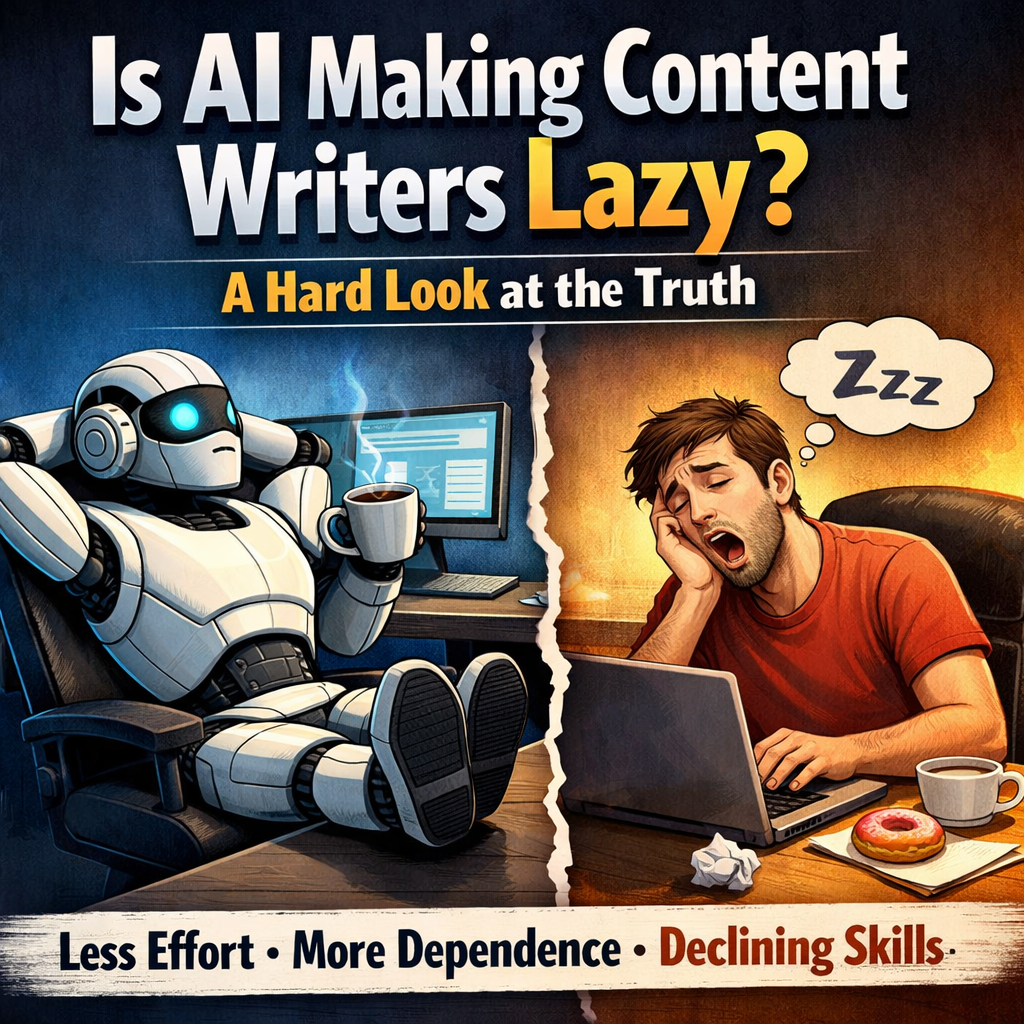
AI has slipped quietly into the writer’s workspace. It suggests headlines, fixes grammar, sketches outlines, and sometimes hands over a full draft before the coffee cools. For many, this feels like relief rather than a threat. Tasks that once took hours now take minutes, leaving writers free for planning, judgment, and direction.
Tools such as Grammarly and others tidy language and structure, while humans decide what actually deserves to be said. A 2023 study even found that students finished essays 35% faster with AI support, without a visible drop in quality.
Speed improved, iteration increased, and deadlines stopped looming like weather systems.
This promise explains the enthusiasm. Journalists already rely on software to condense data into readable reports, not unlike how spreadsheets reshaped accounting without erasing accountants. Few mourn the loss of manual ledgers. In that sense, AI looks less like a thief of skill and more like a shortcut past drudgery. Yet comfort has a way of diluting alertness, and this is where doubts surface.
The Uneasy Case for Laziness
Concerns about mental atrophy tend to follow every new tool. Calculators were blamed for killing arithmetic, and spellcheck for ruining spelling. AI, though, touches a more intimate nerve—thinking itself.
Take this instance for example:
An MIT Media Lab experiment tracked the brain activity of participants writing essays with and without ChatGPT. Those leaning heavily on the tool showed lower neural connectivity, especially in areas linked to creativity and semantic reasoning. Their essays grew increasingly uniform. By the third round, many stopped writing altogether and pasted what the system produced.
This pattern hints at what researchers call cognitive offloading. The brain, sensing a shortcut, steps back. Over time, the habit forms. In contrast, participants who wrote unaided displayed stronger internal idea-building and later used AI more selectively when introduced.
The difference was not talent but posture: one group treated AI as a helper, the other as a stand-in.
When Assistance Turns into Dependence
The risk sharpens in educational and creative settings. A 2025 qualitative study of Indonesian master’s students found that extended AI use eroded confidence in personal style. Several participants admitted feeling uneasy writing without prompts or rewrites from a machine. Grammar vigilance slipped. Original phrasing thinned out.
Writers outside academia echo similar feelings. Online forums carry complaints from novelists and bloggers who feel drained when drafting alone after months of AI-supported outlining. The tool, once praised, becomes a quiet excuse. Initiative fades. Writing turns reactive rather than exploratory.
These accounts do not suggest that AI destroys ability overnight. They suggest something subtler: the slow weakening of mental muscles rarely exercised. GPS did not erase spatial sense in a day, but reliance on it has left many unable to navigate familiar streets unaided. Writing appears to face a similar drift.
Productivity Without Pride
Professional environments complicate the picture. In offices, AI-generated summaries, emails, and reports save time and money. Few object when routine communication is handled faster. Problems appear when convenience replaces care. A journalist who lets a system draft entire articles risks publishing work that feels hollow or repetitive. Readers notice sameness long before editors do.
High-profile missteps reinforce the point. Automated articles passed off as human writing have drawn criticism not because machines were involved, but because oversight was absent. The content felt thin, errors slipped through, and trust took damage. The machine did exactly what it was asked to do. The failure belonged elsewhere.
It Is Still a Human Affair
Experts tend to agree that AI excels at scaffolding, not authorship. Harvard researchers warn against overconfidence in fluent output, noting that polish often masks shallow reasoning. Humans remain better at leaps of insight, tone judgement, and deciding when a rule should be broken. AI predicts patterns—writers decide when patterns deserve disruption.
This distinction matters. Used early in a process, AI can spark angles or organize chaos. Used late, it can clean sentences without flattening voice. Used everywhere, it risks becoming a filter that makes all writing sound faintly related, like cousins who dress alike by accident.
Finding a Working Balance
The emerging advice is practical rather than dramatic. Alternate between AI-assisted and solo writing sessions. Question machine output instead of accepting it. Rewrite drafts by hand, even when a usable version already exists. These habits keep judgment active. They also remind writers that effort carries meaning beyond efficiency.
Some educators now frame AI as a mirror. It reflects habits already present. A curious writer uses it to test ideas. A disengaged one uses it to avoid thinking. The tool does not choose; the user does.
Final Thoughts
AI is not making writers lazy by default. It makes laziness easier to hide. At the same time, it makes discipline more visible. Writers who treat AI as a quiet assistant often produce more thoughtful work, not less. Those who surrender authorship trade pride for speed and rarely notice the exchange until something feels missing.
Go Back
10TH OCTOBER, 2022
 Any Question?Call +91-9903194492